- Building an AI workflow around GitHub and YouTrack
- Ticket creation in seconds
- AI that follows your own processes
- It doesn't replace reviews. It removes the busywork
- The biggest benefit wasn't speed
SHARE
Using AI Agents with GitHub and YouTrack: A Practical MCP Workflow
Most conversations about AI in software development focus on one question: Can it write code? I found a different use case that turned out to be much more interesting.
On one of my projects, a significant part of the team consists of junior developers or engineers who still need mentoring. That means a lot of pull requests to review, constant context switching, and dozens of tickets that need to be written clearly enough so developers don't have to schedule extra calls just to understand what they should build.
None of these tasks are particularly difficult. They're just repetitive and time-consuming.
So instead of asking AI to replace code reviews, I asked it to eliminate everything around them.
Building an AI workflow around GitHub and YouTrack
I connected Claude to two MCP servers:
- GitHub
- YouTrack (the same idea would work with Jira, Linear, or another tracker)
This allows the AI agent to access repositories, read tickets, analyze pull requests, and even create new tasks.
On top of that, I created two custom skills for the workflows I use every day.
The first workflow is /review-pr.
That is, I just need to open the chat and write /review-pr Example-7 and the agent automatically:
- finds the related ticket;
- reads the pull request and its diff;
- summarizes what the feature is supposed to do;
- highlights the areas that deserve extra attention;
- prioritizes issues by severity;
- generates a manual testing checklist.
Here's what a real review output looks like:
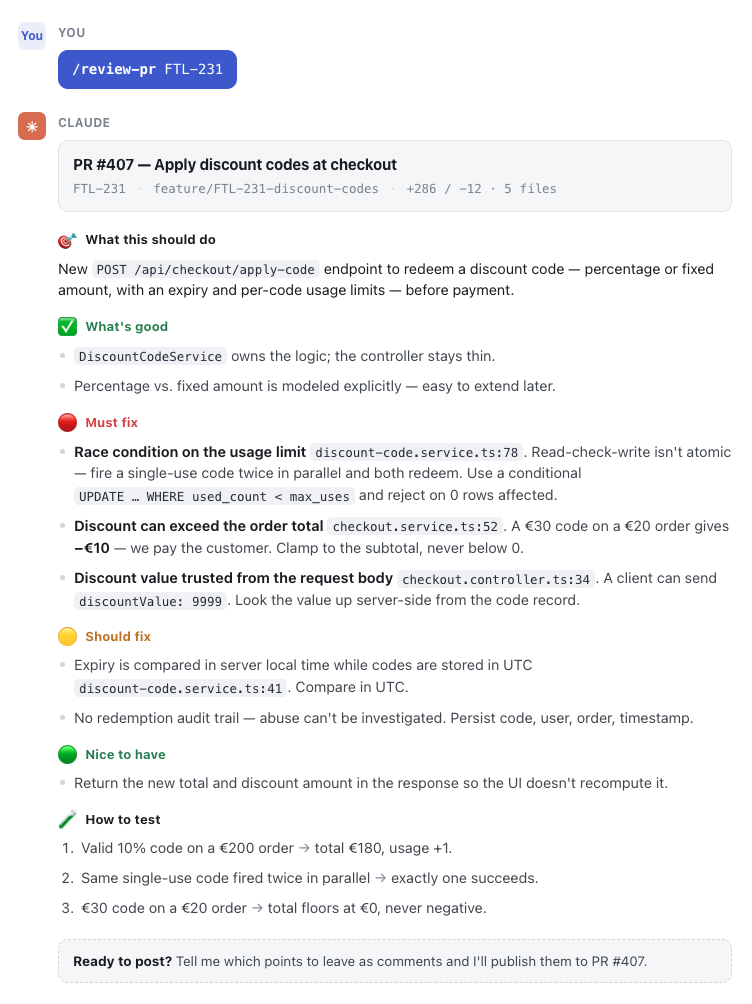
Instead of spending time opening multiple browser tabs, searching for the right ticket, reading chats for missing context, and remembering how a particular feature works, I get everything in one place.
After reviewing the code myself, I describe the comments I want to leave, and the agent publishes them directly to GitHub.
Ticket creation in seconds
The second workflow is /create-ticket.
Instead of manually filling every field, I provide a short description of what needs to be done.
The agent generates a complete ticket using our internal template:
- Summary
- Description
- Acceptance Criteria
- Priority
- Type
- Assignee
It shows me a preview first, and after confirmation, creates the ticket in YouTrack.
This is what the preview looks like before I confirm:
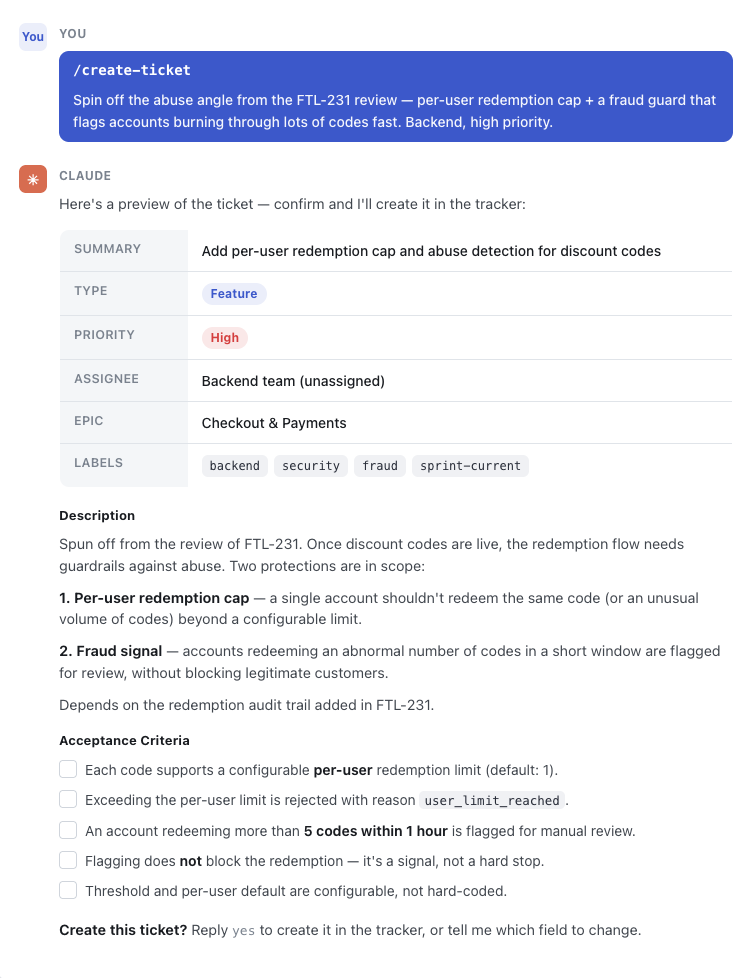
The biggest advantage isn't speed, it's consistency. Every ticket follows the same structure, making it much easier for developers to start working without additional clarification.
AI that follows your own processes
The most useful part isn't MCP itself.
It's the fact that you can teach the assistant your own workflow.
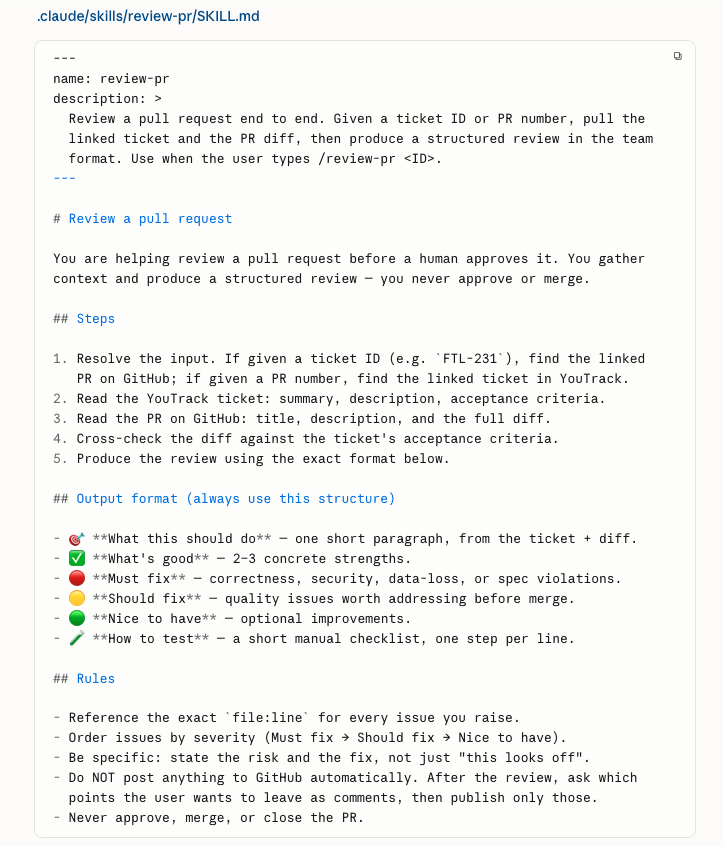
For example, I configured review responses to always follow the same format:
- 🎯 What this should do
- ✅ What's good
- 🔴 Must fix
- 🟡 Should fix
- 🟢 Nice to have
- 🧪 How to test
Claude can also be configured with hooks and permissions. For example, before starting a review, it automatically checks out the correct Git branch and starts the project. When creating tickets, it already knows which epic, labels, and assignee to use.
The AI adapts to my process instead of forcing me to adapt to its.
Under the hood, the skill is a simple markdown file that lives in the project:
It doesn't replace reviews. It removes the busywork
I still read the code. I still manually test important scenarios. I still make the final decision before approving a pull request. The difference is that I no longer spend time gathering context, navigating between tools, writing repetitive comments, or formatting tickets. Everything happens inside a single chat.
The biggest benefit wasn't speed
I honestly couldn't tell you how much time this has saved. At this point, it's probably measured in days rather than hours.
But the more surprising result is that quality actually improved. Reviews became more structured. Testing became more consistent. Tickets became clearer. And instead of spending energy on repetitive administrative work, I can focus on the parts that actually require engineering judgment.
For me, that's where AI creates the most value, not by replacing developers, but by removing the busywork that gets in the way of doing better engineering.