- What Are Claude Fable 5 and Claude Mythos 5?
- A New "Mythos-Class" of AI
- Major Improvements Over Previous Claude Models
- Why Developers Are Paying Attention
- Safety Remains a Core Focus
- What This Means for Businesses
- How Claude Fable 5 Compares to GPT-5.5 and Gemini 3.1 Pro
- Summary
SHARE
Claude Fable 5 & Mythos 5 Explained: Features, Safety, and Use Cases
Anthropic officially introduced Claude Fable 5 and Claude Mythos 5 on June 9, 2026, marking one of the biggest updates in the company's history. These models represent a new generation of AI systems that Anthropic calls "Mythos-class", a tier above the previous Claude Opus models.
The release is important not only because of improved benchmark scores, but because it gives us a glimpse of where AI assistants are heading: from answering questions to managing complex, long-running projects with minimal supervision.
What Are Claude Fable 5 and Claude Mythos 5?
Both models are built on the same underlying architecture and offer Anthropic's most advanced capabilities to date. The main difference lies in access and safety controls.
Claude Fable 5 is the public version available to a broader audience. It includes additional safeguards designed to prevent misuse while still delivering state-of-the-art performance.
Claude Mythos 5 is a more restricted version intended for trusted organizations, cybersecurity teams, and research partners. Some of the guardrails for Fable 5 have been relaxed, allowing access to more advanced capabilities in controlled environments.
In simple terms, Fable 5 and Mythos 5 are essentially the same model, but Anthropic applies different safety policies depending on who is using it.
A New "Mythos-Class" of AI
Anthropic describes these models as the first publicly available members of a new Mythos-class category.
According to the company, Mythos-class models are designed to handle tasks that require deeper reasoning, long-term planning, and sustained focus over extended periods. Instead of simply responding to prompts, they can work through multi-step projects, evaluate their own progress, and coordinate multiple subtasks.
This reflects a broader shift in AI development. The goal is no longer just to produce better answers, but to create systems capable of acting as autonomous collaborators.
Major Improvements Over Previous Claude Models
Anthropic claims Fable 5 outperforms previous Claude generations across coding, reasoning, visual understanding, and agentic workflows. Independent observers who tested the model shortly after launch reported noticeable improvements in handling difficult and lengthy tasks.
Some of the most notable upgrades include:
- Better software engineering capabilities — for example, Fable 5 can analyze a large codebase, identify dependencies across multiple repositories, and help perform large-scale migrations that would normally take engineering teams weeks or months.
- Improved planning and task decomposition — instead of simply answering a question, the model can create detailed execution plans, break projects into milestones, track progress, and adjust its approach as new information becomes available.
- Stronger performance on long-context problems — teams can upload hundreds of pages of documentation, meeting notes, product requirements, and technical specifications, then ask the model to find connections, inconsistencies, or missing requirements across all materials.
- Enhanced image and document understanding — for example, the model can analyze screenshots, charts, dashboards, scientific figures, PDFs, and forms, extract relevant information, and even recreate parts of a web application's source code from visual references.
- More reliable multi-step reasoning — Fable 5 can work through complex business, financial, or technical problems that require comparing multiple variables, evaluating trade-offs, and arriving at a justified recommendation.
- Better self-checking and error correction during complex tasks — when handling long workflows, the model is more likely to identify mistakes, verify intermediate results, and revise its own output before delivering a final answer.
Anthropic also reports significant gains on coding benchmarks, where Fable 5 outperformed previous Claude models and several competing frontier models.
Why Developers Are Paying Attention
One of the strongest early reactions came from developer and AI researcher Simon Willison, who described Fable 5 as a model that feels noticeably larger and more capable than previous Claude releases.
His early testing suggested that the model excels at solving complex engineering problems, maintaining context across long sessions, and completing tasks that require sustained reasoning rather than quick answers. At the same time, he noted that the model can be slower and more expensive to run due to the computational cost.
This tradeoff may be worthwhile for organizations working on sophisticated projects where reliability matters more than speed.
Safety Remains a Core Focus
Anthropic delayed broader access to Mythos-level capabilities for months due to concerns about cybersecurity and misuse risks. Before launching Fable 5, the company conducted extensive safety testing, including external red-teaming and jailbreak attempts.
The company says it released Fable 5 only after implementing safeguards capable of withstanding large-scale testing. According to Anthropic, researchers spent more than 1,000 hours attempting to bypass the model's protections but found no universal jailbreak.
This cautious rollout reflects a growing industry trend: as AI systems become more capable, companies are increasingly balancing innovation with safety and governance.
What This Means for Businesses
For businesses, the biggest takeaway is not a benchmark score but a change in how AI can be used.
Claude Fable 5 is designed to tackle projects that may take hours or even days to complete. It can help with software development, research, analysis, planning, documentation, and other knowledge-intensive workflows that previously required significant human oversight.
For example, software teams can use it to analyze large codebases, identify bugs, generate documentation, or support large-scale migrations. Product and operations teams can turn lengthy meeting transcripts and requirements into structured action plans and project roadmaps. Legal and compliance departments can review hundreds of pages of policies and contracts to identify inconsistencies or highlight important clauses. Customer support teams can build more capable AI assistants that understand context across multiple interactions and resolve complex requests more effectively.
Rather than acting as a simple chatbot, Claude Fable 5 moves closer to becoming a true digital collaborator that can assist teams throughout entire workflows, helping organizations improve productivity and focus human expertise where it matters most.
How Claude Fable 5 Compares to GPT-5.5 and Gemini 3.1 Pro
When a new frontier AI model is released, one of the first questions businesses ask is: how does it compare to OpenAI and Google?
According to benchmark results published by Anthropic, Claude Fable 5 delivers some of its greatest improvements in software engineering, long-horizon reasoning, and autonomous task execution. On SWE-Bench Pro, a benchmark that evaluates real-world software engineering tasks, Fable 5 achieved 80.3%, outperforming GPT-5.5 (58.6%) and Gemini 3.1 Pro 3232
(54.2%).
The model was specifically designed for complex projects that require sustained focus over long periods. Anthropic claims that Fable 5 can maintain context, plan multi-step workflows, and work on tasks that may take hours or even days to complete.
However, choosing the "best" model still depends on the use case.
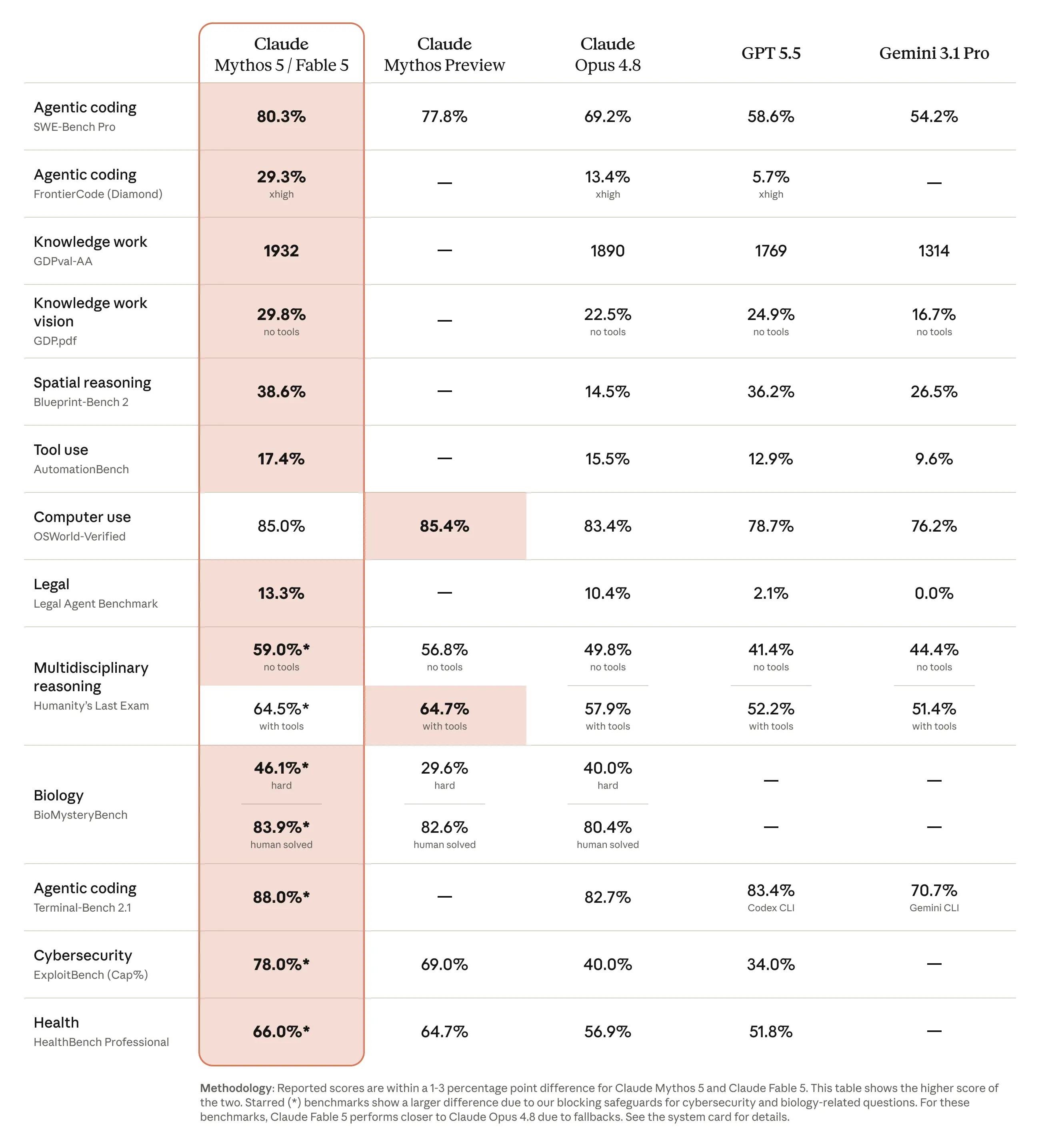
Early community testing suggests that Claude Fable 5 is among the strongest coding and reasoning models currently available, though GPT-5.5 and Gemini remain highly competitive in areas such as advanced multimodal tasks and general-purpose assistance.
Rather than replacing GPT or Gemini, Claude Fable 5 expands the landscape of frontier AI. Organizations can now choose among models increasingly optimized for different goals— whether that's coding, content generation, research, automation, or multimodal experiences.
Summary
Claude Fable 5 and Claude Mythos 5 represent a significant milestone for Anthropic. Rather than focusing solely on larger context windows or benchmark wins, these models are built around long-horizon reasoning, planning, and autonomous task execution.
While access to the full Mythos 5 experience remains limited, Fable 5 offers the public its first opportunity to work with a Mythos-class model. Early feedback suggests that Anthropic has delivered one of the most capable AI systems currently available.
The real test, however, will be how businesses and developers use these capabilities in production over the coming months. If the early results hold up, Fable 5 could become one of the most influential AI releases of 2026.